
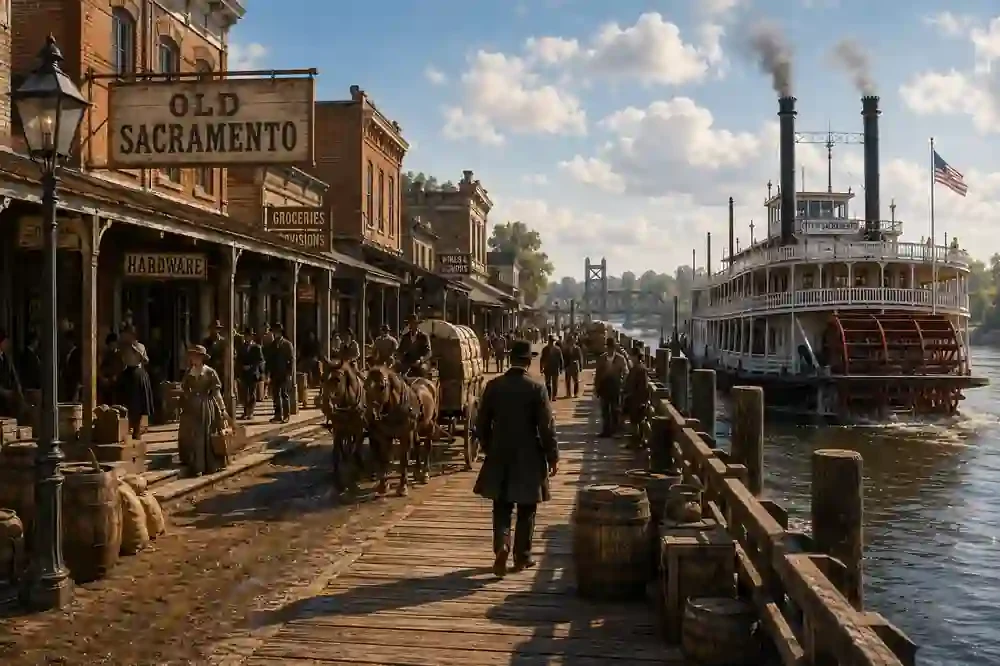
Historically, Sacramento is most famous as the epicenter of the 1849 California Gold Rush, the permanent State Capital of California (designated in 1854), and the western terminus of both the Pony Express and the First Transcontinental Railroad. Known historically as the “Indomitable City,” Sacramento transformed from a small river outpost into one of the most vital transportation and political hubs in Western American history.
Long before European settlement, the region around the Sacramento and American Rivers was inhabited for thousands of years primarily by the Nisenan and Plains Miwok peoples. Understanding Sacramento’s historical footprint requires looking at the major events that transformed this river valley into the heart of the Golden State.
1. The 1849 California Gold Rush Epicenter
Sacramento’s rise began in 1839 when Swiss pioneer John Sutter established Sutter’s Fort (originally called Nueva Helvetia) as an agricultural and trading outpost.
Everything changed on January 24, 1848, when James Marshall discovered gold flakes at Sutter’s Mill in nearby Coloma. The discovery sparked the world-famous 1849 California Gold Rush. Because of its location at the confluence of the Sacramento and American Rivers, Sacramento quickly became the primary supply depot and gateway for hundreds of thousands of fortune seekers (“49ers”) heading into the Sierra Nevada foothills.
The riverfront trade at Sutter’s Embarcadero grew exponentially, forming the settlement that was incorporated in 1850 as the City of Sacramento.
Today, properties with rich historical backgrounds or aging architecture often change hands as the city expands. Established cash home buyers like R&H Distressed Properties help modern homeowners navigate property transitions in historical regions like Sacramento without needing costly structural overhauls.
2. The Western Hub of American Transportation
Sacramento earned its reputation as the central logistics engine of the West by anchoring the nation’s most groundbreaking transit projects:
- The Pony Express (1860–1861): Sacramento served as the western terminus for the legendary cross-country postal route. Riders carried mail across nearly 2,000 miles from St. Joseph, Missouri, cutting communication time between the East and West Coasts down to just 10 days.
- First Transcontinental Railroad (1869): Groundbreaking for the Central Pacific Railroad took place in Sacramento in 1863. Financed by the famous “Big Four” Sacramento merchants—Leland Stanford, Collis Huntington, Mark Hopkins, and Charles Crocker—the rail line built east from Sacramento to meet the Union Pacific Railroad, permanently uniting the United States by rail.
3. The Permanent Capital of California (1854)
During California’s early statehood, the capital moved between several locations, including Monterey, San Jose, Vallejo, and Benicia. In 1854, Sacramento was officially named the permanent seat of California’s state government.
Driven by the wealth of the Gold Rush and its central geography, the city constructed the neoclassically styled California State Capitol building between 1860 and 1874. It remains the center of political power for the world’s fifth-largest economy.
4. Historical Timeline: Major Events at a Glance
| Year | Event | Historical Significance |
| 1839 | Sutter’s Fort Established | John Sutter founds Nueva Helvetia, the area’s first European settlement. |
| 1848 | Gold Discovered at Sutter’s Mill | Sparks the California Gold Rush, bringing global fortune seekers. |
| 1850 | City of Sacramento Incorporated | Becomes one of the first officially incorporated cities in California. |
| 1854 | Designated Permanent State Capital | Sacramento becomes the permanent political center of California. |
| 1860 | Pony Express Terminus | Establishes direct express mail delivery to the Pacific Coast. |
| 1862–1870s | The “Raising of Sacramento” | Streets and buildings raised 10–15 feet to combat catastrophic flooding. |
| 1869 | Transcontinental Railroad Completed | Connects the West Coast to national markets starting from Sacramento. |
5. Engineering Marvel: The “Indomitable City” & Sacramento Underground
Sacramento’s low-lying position near two major rivers made it prone to severe flooding. After devastating floods in the 1850s and the Great Flood of 1862, city leaders undertook one of the most ambitious engineering projects of the 19th century.
Between 1862 and the mid-1870s, citizens literally raised the downtown street level by 10 to 15 feet using thousands of wagonloads of dirt. Building owners converted their original first floors into basements and vaulted sidewalks. Today, these historic spaces form the famous Sacramento Underground.
6. From Gold Rush to Agricultural Powerhouse
By the late 19th century, gold production declined, but Sacramento’s fertile Central Valley soil provided a new economic foundation: agriculture.
Sacramento became a primary processing, canning, and shipping point for crops distributed across North America via the transcontinental rail line. This agricultural legacy directly shaped Sacramento’s modern identity as “America’s Farm-to-Fork Capital.”
Historic Landmarks You Can Visit Today
- Old Sacramento Waterfront: A 28-acre National Historic Landmark featuring preserved 1850s architecture, wooden boardwalks, and cobblestone streets.
- California State Railroad Museum: Located in Old Sacramento, this world-renowned museum showcases restored locomotives and artifacts from the Transcontinental Railroad era.
- Sutter’s Fort State Historic Park: Located in Midtown Sacramento, offering living history exhibits inside the restored 1830s adobe fortress.
- California State Capitol Museum: Tour historic state offices restored to their 19th-century appearance alongside modern legislative chambers.
Frequently Asked Questions
Why was Sacramento chosen as the capital of California?
Sacramento was chosen as the state capital in 1854 due to its rapid population growth during the Gold Rush, river transport access, central geographic location, and strong political push by local leaders.
Why is Old Sacramento underground?
City officials raised the street level of downtown Sacramento by 10 to 15 feet during the 1860s to prevent recurring flood damage from the Sacramento River. The original street-level storefronts became underground spaces.
What Native American tribes originally lived in Sacramento?
The land surrounding the confluence of the Sacramento and American Rivers was inhabited for thousands of years by the Nisenan and Plains Miwok Native American tribes prior to European settlement.